First Two Weeks with the 52nd Ohio
 |
| Colonel Daniel McCook of the 52nd Ohio Volunteer Infantry, "Colonel Dan" to his troops, fell at Kennesaw Mountain, Georgia on June 27, 1864 while leading his brigade in a charge upon the Confederate works. |
When on August 21, 1862, I joined Captain James Taylor Holmes
company en route to Camp Dennison, Ohio, it was on the condition that 7 members
already enrolled must be rejected by physical examination or join other
companies. To explain to those who have grown up since the close of the war, as
well as to refresh the memories of those we became identified and part of the
300,000 more of 1862, I will state that if a volunteer chosen to select his
associates in an Ohio company or regiment there were qualifications other than patriotism
precedent to being sworn into the army.
I recall one
experience of my attending a war meeting in an old log Methodist meeting house,
dimly lighted with tallow-dip candles held in place by tin reflector candlesticks,
hung on the sides of the long walls. The audience was made up of farmers and
their families addressed by a circuit preacher, a typical Methodist, eloquent,
enthusiastic, and intensely patriotic. Everybody’s war feeling was stirred up
to the highest pitch by his appeals for volunteers.
As soon as he
called for recruits to enroll their names, I signified my wish to join the company.
I lacked a few days of being 18 years of
age which was waived. His next question was “Are you a member of the church?’ I
replied that I was not. He then explained to me that the presiding elder of the
district was to be captain of the company and that every member enrolled must
be a member of the Methodist or other Christian church. This qualification
rendered me ineligible and his very feeling expressed not only his personal
regret but the sentiments of those present to all of whom I was personally
known.
I was anxious
to enlist in this particular company because my parents were staunch Methodists
and I felt that the influence and associations of a Methodist company would in
no small degree reconcile them to my going to war. It was on the day following
this episode that I learned that Captain Holmes was enrolling a company in an
adjoining county distant about 50 miles. This was my second attempt to enlist
and was successful.
After joining
Captain Holmes’ company, we arrived at Camp Dennison about 10 p.m. In the
morning we formed in line and the captain called out our names preparatory to
being mustered into the service. After a roll call, the last 7 names on the
roll were in excess of the number allowed by army regulations, and mine being
the last one, we were given the choice of joining another company or backing
out altogether. This was adjusted by the excess volunteering in Co. F and in
order to get into the company, I gave one of the boys my first month’s pay of
$13 to allow me to take his place while he joined another company.
We were
mustered and sworn in to serve three years or during the war and assigned as
Co. G of the 52nd Ohio Volunteer Infantry under Colonel Daniel
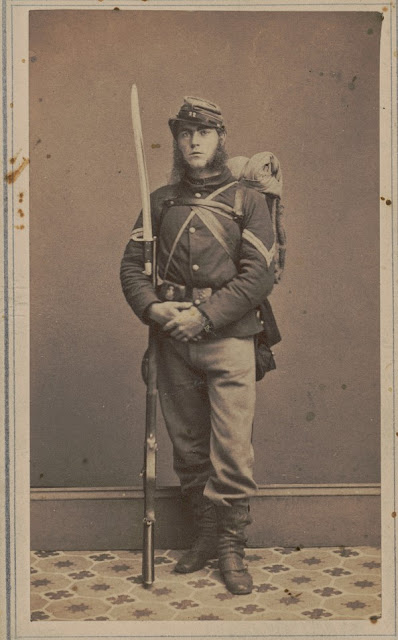
McCook. The equipment of the company began the moment we returned to our
quarters and was pushed with vigor. No veteran ever recalls this period of
transition without audibly smiling at the ludicrous makeup of himself as well
as everybody else. Our uniforms were issues to us from piles of each garment
and as you passed the sergeant, he handed you a pair of pants and so with the
blouse, shirt, cap, socks, shoes, etc. without reference to size, leaving each
to fit himself as best he could but by swapping around, we succeeded in getting
an average fit from shoes to cap.

Once in
uniform, our citizen Sunday clothes were sent home by the first express, save
that some of the boys were foolish enough to retain and lug around a new pair
of boots in anticipation of a march on rainy days. As a rule, however, we got
rid of them before we ever had such a day. We were armed with Springfield rifles
and given more military toggery than we knew how to adjust. Most of us were
country farmers’ boys who had seen but few soldiers in war equipment, but by
persistent effort we managed to harness our manly forms with all the belts,
belt plates, cartridge and cap boxes, canteen, haversack, and knapsack; the latter
was chock full with a wool blanket strapped on top. After this lapse of time, as
I recall our neat and trim appearance at this period, I am persuaded that we
never again attained so much newness of raiment…
On the 25th
of August, on our fourth day of service, we marched through Cincinnati and were
drawn up in front of the courthouse and the regiment presented with a stand of
colors. On old glory was inscribed “52nd Ohio Vol. Infantry” and on
our U.S. flag was inscribed “McCook’s Avengers.” [He is likely referring to the
regimental colors] Owing to the very dark shade of blue of this flag and the motto
theron, when General Buell’s veterans met us between Bardstown and Louisville
in September, some Missouri German regiment [2nd or 15th
Missouri] called attention to the “black flag.” The report was spread and
credited throughout the army that Colonel Dan McCook’s regiment carried a ‘black
flag” and that it was recruited to avenge the murder of Colonel Robert McCook,
a brother of our colonel.
 |
| 52nd Ohio regimental colors, the "black flag" |
The
presentation over, we crossed the Ohio to Covington, Kentucky and after partaking
of a dinner furnished by the citizens, at 10 p.m. we embarked on the cars for Lexington,
Kentucky where we arrived at 8 a.m. on Tuesday, August 26, 1862. We went into
camp in the suburbs on the left of the Nicholsville Pike. We became part of the
Army of Kentucky under General William Nelson with headquarters at Lexington. We
had two brigades of infantry and Lexington and a few cavalrymen under the
command of Colonel T.T. Garrard of the 3rd Kentucky Cavalry. Generals
Manson and Cruft were at Richmond 26 miles further south with two brigades of
infantry. General Dumont had a division in and about Lebanon while General
George W. Morgan was hemmed in at Cumberland Gap. We had a brigade at Nicholsville
and some regiments at Frankfort and Versailles, in all about 16,000 troops, all
scattered over a day’s march from headquarters, not counting General Morgan’s
force in Cumberland Gap.
When General
Nelson left Lexington on August 30 for Richmond, he turned command of the post
over to Colonel Dan McCook who, having received a message from General Manson
for help, transmitted it to General Horatio G. Wright, department commander at
Cincinnati, who instructed Colonel McCook to send a brigade to reinforce Manson
at Richmond and if he had no good colonel available, to take the command
himself. It was upon the receipt of this order on the afternoon of August 30
and on our ninth day of service when our nerves were at the highest tension
from listening to the sounds of cannonading all morning from the direction of
Richmond that Colonel McCook rode up to regiment headquarters and immediately,
the long roll was beat. The 52nd Ohio fell into line, in all shapes
of equipment, and answered the roll call by the orderly sergeants. While the
drums were still beating, Adjutant Charles H. Blackburn came and gave our
captain some verbal orders, the 52nd formed into line in light
marching order, and before it got dark, we were marching toward the Kentucky
River 16 miles distant.
The suddenness
of our change from rural life to marching towards the field of battle was only
relieved by the many camp rumors in circulation. In fact, our happiness and
joys of life depending upon our being kept fully informed of every movement of
the army, especially as it related to our command. The war news which we received
personally and swallowed verdantly answered the purpose admirably. As soon as
we reached the outskirts of town, we passed a vineyard on the right of the pike
and the regiment began to forage at will. The regiment was halted and the
foragers arrested followed by an order issued forbidding officers or soldiers
from leaving the ranks. This was our first taste of real discipline.
The summer of
1862 had been one of unusual drouth in Kentucky; the days were dry and hot, the
fields of grass were parched and brown and the rough, stony pike was ankle deep
with dust. The streams, springs, wells, and pools were dry, our canteens empty,
and no details were allowed to go for water even had we known where to find it.
To add to this, being the advance regiment, we were continually meeting fleeing
squads of Manson’s and Cruft’s scattered forces. The videttes sent them back to
the head of the regiment where they would tell of their defeat and describe the
battle. During these parleys, the regiment would halt in the dusty pike in
line.
We met Colonel
T.T. Garrard and part of his regiment, the 3rd Kentucky Cavalry,
returning from Clay’s Ferry, the point where the Lexington and Richmond pike
crossed the Kentucky River. He told the colonel of Manson’s utter rout and
defeat; the road was full of stragglers escaping from the battlefield. Colonel
McCook decided to proceed to and hold the ferry. During the night, we met
General Nelson in an ambulance which halted near where I stood. Colonel McCook
rode up beside the ambulance and I heard General Nelson tell him that he had
destroyed the ferryboat at the ferry and that the enemy could not follow.
Colonel McCook
said he would advance and hold the ferry, protecting such fugitives as escaped.
General Nelson said all right but to take his regiment and cover the retreat,
adding, “Colonel, we are whipped and whipped like hell. Use your judgment and
do the best you can.” Nelson certainly expressed his feelings and the situation
concisely.
During the night on our advance
to the river, while making one of our halts, we had become so tired and thirsty
that as soon as we halted we sank down exhausted in the road on either side. We
had been subjected to alarms constantly during the night by picket firing, but
always from the front or flanks. This time the alarm came from the rear while
we were halted in a wood. We could hear horses galloping and chains rattling on
the flinty pike and somebody in the rear cried “Morgan’s cavalry!” Half awake,
I jumped over the bank of the pike and landed in a bunch of pokeberry bushes in
a fence corner minus my gun. The 52nd Ohio stampeded but soon
rallied. Nobody acknowledged having broken ranks but stories of hairs-breadth
escapes from death were thrilling in the extreme. The alarm was caused by a
mule with doubletrees attached to his harness which came charging down the
middle of the pike clean through to the head of the regiment.

I was lucky enough to recover my
gun but my messmate lost his gun and cap. The loss of his gun and cap
necessitated upon his part prompt action. Therefore, he found a comrade of Co.
K sleeping soundly during our next halt and gently relieved him of his cap and
gun. He discreetly removed the K from the cap and with spit made a mud clay and
rubbed it over the K spot, erasing every vestige of identification.
We reached the
river after an all-night march of 16 miles about an hour after sunrise and
camped in Shep Roger’s orchard on the right of the pike with pickets advanced
to Clay’s Ferry at the Hacker House. On the opposite side of the river was Mrs.
Reins’ plantation. About 10 a.m., the Rebels planted a battery on the brow of
the hill beyond the Reins’ House on the opposite side of the river and shelled
us out of the orchard. We fell back out of range over the hill and commenced
our retreat to Lexington. As we were in full retreat to Lexington, the comrade
from Co. K came along the company bareheaded and foot blistered, cursing
everybody and the thief in particular.
Our retreat to Lexington was a trying march
under a tropical sun on a dry, hot, dusty pike; no water to be had. Besides, being
the rear guard, we had no opportunity of getting it. Our greatest and most
intense suffering was for water, not to mention the lack of rations and rest.
Before we reaching Lexington, we were so fagged out that we had thrown away,
little by little, every article of surplus clothing and camp equipment and we
emerged like veterans of two years’ service so far as equipage goes. We made a
march of 32 miles in less than 30 hours. Such a march under such conditions
would have tested the staying powers of any veteran of the 14th
Corps two years later.
 |
| General Horatio G. Wright |
We marched out
to our old camp and rested 5 hours. On Monday morning September 1, we marched
out on the Nicholsville pike about 3 miles, deployed in line of battle and
threw out skirmishers. About dark we marched back and when we reached our camp,
we found it burning and kept on through the town. General Horatio G. Wright had
arrived in Lexington and ordered its evacuation and by an order dated
Louisville, Kentucky on September 1, 1862, commissioned Captain Charles G.
Gilbert of the Regulars as a major general of volunteers in command of the Army
of Kentucky and ordered him to conduct the retreat. I believe it was intended
that we should march to Cincinnati but after he had left that point and we
started to march, this was found impracticable, and our destination was changed
to Louisville.
Our regiment
covered the retreat. I believe we passed through Paris during the first night
and Versailles also, arriving at Frankfort between 9-10 p.m. on Tuesday night.
We filed left into a cemetery where we lay a short time and then moved into the
town. This was our second march and occupied 28 hours. I was so nearly
prostrated by the long night and day’s march, suffering for water and rations,
that I cannot remember where we camped. I know that as the sun was rising
Wednesday morning, we were ascending the bluffs on the opposite side of the
river and could see the Confederates with a battery arriving above the city
along the riverbank.
The day before,
we had formed in line of battle several times to check the Confederate cavalry
and our skirmishers had exchanged shots with their advance. We had two brass
James rifles with us which n these occasions would unlimber and make a great
show of shelling the Rebel advance, but it was understood that these guns did
not have a round of ammunition nearer than Cincinnati. As soon as we had
checked the enemy and while they were forming, the battery would limber up and
retire at a gallop and we would fall in behind and double quick for two or
three miles. There are two roads leaving Frankfort which form a junction about
16 miles from the city; we marched on the one to the left.
About 11 .am.
when our column was within about 2-3 miles of the forks of the pike, we could
see on the pike to our right nearly a mile distant a dense dust and the head of
a column of cavalry. The rear of our regiment was a little in advance of the
head of this column which we at once recognized as Confederate cavalry. We
double quicked to the forks of the pike and the 52nd formed across
them. We had a slight skirmish, sufficient to check the cavalry and force them
to form in line of battle. The delay occasioned by this movement gave us time
to again retreat.
At intervals, sometimes
hourly, this program was gone through. Nine times on this day our regiment
formed in line of battle to check the Rebel advance with the same result each
time- a gain of time and distance in retreat. We marched till about 10 p.m.
and, after crossing a ridge, camped on a slope which led down to a dry stream
save some pools in the bed of the creek. I was the youngest man in Co. G except
one and as soon as we halted had volunteered to take some of the boys’ canteens
and hunt some water.
Before I got started, the
orderly sergeant detailed me for picket duty and I was, with some others,
marched back to the brow of the hill and put on vidette post about 300 feet
from the top of the hill. This was my first duty on picket. The officer was
careful to instruct me in my duties and warned me of the penalty if found
sleeping on my post. I was to be alert and not let anyone approach too near. The
Rebels were following close and if they tried to capture me I was to fire and
fall back on the reserve post. I was not only tired but I was almost dead with
thirst and want of rest. I tried to act cheerful but I was so near a panic from
fright that I was afraid to go to sleep.
 |
| Picket duty on a lonely night proved one of the toughest tests for new recruits. |
I kept pacing back and forth
across the pike and stopped often on the side to listen for sounds of advancing
Rebels. I could hear the rumbling noise of wagons in our front but the
stillness in the rear was oppressive. For a time after first being posted and
until I became familiar with the surrounding objects, I went through an immense
mental strain which gradually wore off as I neared the end of my time. My pride
regained supremacy over my mind and actions, and I thought how I would tell the
man who relieved me that I had not see or heard anything to disturb me. I
argued to my satisfaction that this action on my part would remove any
suspicion of my lacking courage. I am not ashamed to say I was badly nervous. I
had to keep moving for fear of going to sleep and after I had stood, as I supposed,
my two hours and no relief came, I called for the corporal of the guard but
could get no response.
After debating in my mind what
best to do, I determined to go back to the reserve picket post over the hill
and see about being relieved. It was now about 2 a.m. and I had been on post
nearly 3 hours. When I got to the reserve post everybody was sound asleep. I woke
them up and accompanied the relief to my post and was relieved with permission
to go to the regiment and get something to eat. When I found it, the fires were
burning and a few men here and there of the regiment were asleep and some
non-commissioned officers were waking them up and directing them to hurry forward
after the regiment which they told me had been gone about an hour. I followed
and when I got to the stream I found a stagnant pool of water in the bed of the
creek which the mules had thoroughly stirred up. I scooped out a hole in the
sand and gravel in the edge of the pool, through which the water filtered muddy
and warm. I lay down and drank heartily; to me, it tasted sweeter than any
before or since.
About daybreak I got some apples
for breakfast and about 9 a.m. caught up with the regiment. Captain Holmes had
taken sick on our return from the Kentucky River and remained in Lexington and
was captured. First Lieutenant Rothacker was in command of the company and I
reported to him. He told me he supposed we had been relieved and ordered to
rejoin the command. I told him I had not had anything to eat since the morning
previous at Frankfort except hardtack and water and that I did not believe I
could keep up much longer. He urged me to keep with the company and he would
try and get with the surgeon to put me in one of the omnibuses which we had
pressed into service as ambulances and let me ride an hour or two to rest me.
There were too many already unable to march, prostrated from heat and thirst
and I marched with the company all day. These two days and one night’s service
without rest added to what I had already passed through was only performed
under circumstances of preferring to march rather than being captured.
We were drawn up in line of
battle three times on Thursday September 4 and the same program gone through as
the day previous. We marched all Thursday night and reached Louisville on
Friday September 5 about 2 p.m. From dark Monday night September 1 to 2 p.m. on
Friday September 5 we marched 92 hours and I only slept 7 hours. In five days
and nights we had marched 170-180 miles, acting as the rearguard of a
retreating army which not only required constant duty but the strictest test of
discipline. I remember one time when we halted in the road some colored people
came running to us with buckets of water which we were not allowed to step from
the ranks to get, though we were suffering almost beyond endurance.
Corporal Keller Crab of our
company stepped out to the side of the road to get a drink and Colonel Dan
McCook tried to ride him down and struck him with his sword. The corporal
jumped back and attempted to shoot the colonel, but someone grabbed his gun and
he was put under arrest, but afterwards Colonel McCook released him. I saw men
reel and fall helpless on the roadside while others staggered and crawled into
the fence corners out of the way of troops and mounted officers. They would
lean up against the fence in a half reclining position with their heads on
their breasts and faint, turn black in the face from sunstroke, and die before
relief could be afforded.
 |
| General William Nelson |
I witnessed a
general officer endeavor to make his horse trample upon men lying helpless,
cursing and damning them to get up and join their commands. I expected to see
them trampled to death but the horse was more humane than the rider and would
step over their prostrate bodies. These scenes were talked over by the boys
afterward and it was the impression that it was General Nelson who attempted
these outrages, but since I find that Nelson went direct from Lexington to
Cincinnati, it must have been one of our critics who afterwards had so much to
say in condemnation of so many raw troops being captured on this retreat.
Whoever it was there are many survivors of the 52nd Ohio who will
recall these scenes which, to raw troops, left a rankling feeling against
Nelson never since fully eradicated.
I concede we
lacked training, skill, and discipline. We were raw troops but the facts are
that, so far as the 52nd Ohio in concerned, such censure is unjust
and our critic resorted to this base subterfuge to cover his incompetency and
cast a stigma upon men who in many instances died in their tracks. There was no
more severe test of physical endurance in any subsequent campaign. Our colonel
displayed energy and those soldierly qualities which as time passed endeared
him to every man in the regiment. Our confidence in him and his trust in us grew
out of the actions of the regiment when in line repelling the advance of the
enemy and his praise of our record is a hallowed memory.
We were met about 15 miles outside of Louisville by a reinforcement. We marched in on the Shelbyville Pike. Once inside our lines, we marched leisurely and rested often, going into camp on September 5 about 2 p.m. in the suburbs of the city in a grove on the right of the pike where we rested and slept until the next day when we again marched through town to the Two-Mile House on the pike leading southwards, camping in a grove where we remained. We threw up rifle pits during the day and every morning at 2 a.m. we were called out to stand in them to repel any attack. This routine was kept up till General Buell’s army began to arrive on the 25th. On the 20tj we marched to Sunburnt Hill on the Bardstown Pike to meet the advance of General Buell’s army and it was here that we received the name of the Black Flag regiment as previously explained.
Source:
“Army of Kentucky: Story of Kirby Smith’s Second Invasion,”
by “One of McCook’s Boys,” Co. G, 52nd Ohio Volunteer Infantry, National
Tribune, February 20, 1896, pgs. 1-2; also, February 27, 1896, pgs. 1-2


Comments
Post a Comment