From Poltroons to Heroes: The Redemption of the 17th Iowa
Following his army’s victory at the Battle of Iuka, Mississippi on September 19, 1862, General William S. Rosecrans lavished praise on numerous regiments of the command for their steadfast fighting. One regiment, however, was called out: the 17th Iowa Infantry.
Burt Axton, reporting for the Cincinnati
Commercial on September 23 pointed out that “censure is cast upon the 48th
Indiana, 80th Ohio, and 17th Iowa for misconduct in
action, but how far their fault is attributable to the incompetency or
poltroonery of the officers remains to be investigated.” The subsequent investigation
by Rosecrans’ staff absolved the 48th Indiana of misconduct noting
that regiment posted on the left of the Union line “held its ground until the
brave Eddy fell and a whole brigade of Texans came in through a ravine on the
little band and even then only yielded a hundred yards until relieved.” The 80th
Ohio was similarly absolved of blame.
But General Rosecrans concluded that “he must mention the
conduct of the 17th Iowa whose disgraceful stampeding forms a
melancholy exception to the general good courage of the troops,” General Orders
No. 130 read. “He doubts not that there are many good officers and men in that
regiment whose cheeks must burn with shame and indignation at the part the
regiment acted and he looks to them and to all its members on the first
opportunity, by conspicuous gallantry, to wipe out the stain on their fair name.”
Just a few weeks later, the 17th Iowa would do just that by capturing the battle flag of the 40th Mississippi during the second day of the Battle of Corinth.
 |
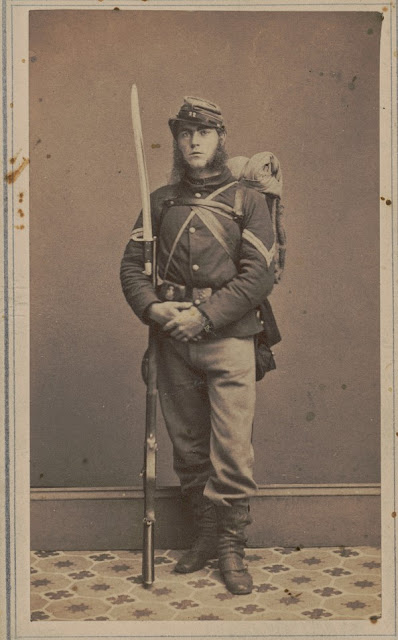
| The 17th Iowa first "smelled powder" at the Battle of Iuka and would go on to a lengthy and successful career with the Army of the Tennessee. |
In the wake of Iuka, several soldiers from the 17th
Iowa sent missives to their local newspapers to explain what occurred. “I
should not have troubled you with this communication but I learn from the
commissioners from Iowa that the people are under the impression that the 17th
acted cowardly, which I feel bound to contradict,” Orderly Sergeant Littleton
W. Huston of Co. B stated.
“General Rosecrans’ order reflects severely on the 17th
Iowa, which every member of the regiment regrets and more particularly than
they would was it not that they feel conscious that they had done their duty as
near as they could under the circumstances,” he continued.
“We were double quicked for more than a mile to the field and
were halted in a road running at right angles with the line of battle and stood
at least 10 minutes under a galling fire, the general seeming undecided about the
position we should occupy,” Huston wrote. “About this time our major was
ordered under arrest by General Sullivan which left us with but one field
officer, Colonel Rankin who was at the right of the regiment and did not know
that the major [S.M. Wise] was arrested until the next morning. Consequently,
the left wing of the battalion was without a commander when we were ordered to
move into position.”
“The left wing could hear nothing of General Sullivan’s order
and was thrown quartering across the road just as some general’s staff and
orderlies (it was said to be General Rosecrans’) stampeded along the road and
through the left wing of our regiment which entirely disorganized two or three of
our companies on the left, some men being knocked down and run over.”
“We formed our companies as soon as possible near the ground
we occupied when broken by the staff and went into the field as best we could
with the regiment in this disorganized condition. Colonel John W. Rankin was
soon disabled by being thrown from his horse [one soldier noted that “Col.
Rankin had his horse shot from under him, one of his shoulder straps knocked
off and his holsters carried away. His horse in falling, throwed him on his
head and disabled him for the fight” while another said that Rankin fell on his
head when his horse was shot down which rendered him “perfectly crazy”]; then
Captain Archer assumed command and soon fell wounded. Captain Young of Co. A
had in connection with Captain Archer assumed command and continued in command during
the fight. Notwithstanding all these difficulties, the regiment to a man nearly
went into the fight and did their share towards defeating the Rebels, but in
such a manner as not to receive proper credit for it,” Huston concluded.
 |
| Colonel John W. Rankin 17th Iowa Infantry |
As the 17th Iowa fell back under a severe
crossfire from the enemy, they stumbled into a friendly fire from the troops of
the 39th Ohio which had just arrived on the field. “The 39th
Ohio coming up to our relief mistook us for a Rebel regiment and poured into us
a volley which was impossible for human bravery to stand,” one soldier
recalled. “The fire flashed in our very faces. The men broke past them, telling
them for God’s sake not to kill their own men!”
Despite these misfortunes, the editors of the Council
Bluffs Nonpareil offered that the true reason why Rosecrans’ staff called
out the 17th Iowa “is not so much attributed to the unsoldierly
conduct of that regiment upon the field as to the fact that their existed a feeling
of personal ill-will in the mind of the commanding general toward the commanding
officer of the 17th,” the newspaper said. However, the Davenport
Daily Democrat and News reported on October 6th that “we have
heard from soldiers on that battlefield from other regiments who attribute the
disgrace entirely to the drunkenness of the commanding officer Col. Rankin and
the incompetency of the other officers. There is the secret of it- whiskey. If
it is true that Col. Rankin was reeling in his saddle on that day, let it be
known and let the blame fall right where it belongs.” One officer of the 17th
argued that “the truth is, the conduct of the 17th Iowa would never
have been censured, had it not been for the malice of a certain brigadier, and
the disappointment of a certain aspiring captain, who dared in no other way to
strike at the reputation of Colonel Rankin.”
Within days, Colonel Rankin submitted his resignation (apparently
for health reasons) which was accepted. “I leave the regiment without the
slightest ill-will or unpleasant feeling to any member,” his farewell order
read. “Inexperienced, I took the command. For a long time sick, I struggled on
in the infirmity of a diseased body. If I have ever done a single person a wrong,
I ask his forgiveness. As your officer, I tried to do my duty.” A resolution signed by all of the surviving
officers of the regiment praised Colonel Rankin as a “heroic commander whose
whole time and energies have been devoted to the improvement, discipline,
health and comfort of the men of his command.”
 |
| The consensus opinion among the members of the 17th Iowa was that Colonel Rankin's reputation (and indirectly that of the regiment) was undone by a combination of poor health and the personal ill-will of his Hoosier brigade commander, General Jeremiah C. Sullivan pictured above. |
Command of the regiment fell to Captain Charles S. Young. As
part of the Second Brigade (Sullivan), Third Division (Hamilton) of Rosecrans’
Army of the Mississippi, the regiment redeemed itself fully at Corinth. But as
the regiment was marching towards Corinth on October 3, Major Jabez Banbury of
the 5th Iowa was assigned temporary command of the 17th
Iowa.
“The 17th Iowa, smarting under the censure which
the men believed had been hastily cast upon them for their conduct at Iuka went
into the battle of Corinth with a stern determination to wipe out the stain
from its reputation,” Lurton Ingersoll noted. “There never was a prouder success.
They fought during the entire engagement, first on the right of General
Sullivan’s brigade and afterwards where they could find the most Rebels. It was
at the very crisis of the battle when Davies’ division had given way, the
Rebels had penetrated into the town, and all seemed lost, that this regiment by
a splendid charge arrested then turned back the column which had till then been
making such fearful headway and followed it up in its confused retreat long
enough to capture a stand of colors.”
Those colors, belonging to the 40th Mississippi,
were captured along with the Confederate color bearer by Corporal John King of
Co. G. Major Banbury noted with pride that “not a man evinced the slightest
inclination to shirk or fall back, but all, without a single exception, stood
up to the work nobly and with an apparent determination to drive the Rebels
back at all hazards.”
General Jeremiah Sullivan wrote a letter to Governor Kirkwood
of Iowa on October 14 proudly presenting “a stand of Rebel colors captured
under my own eye by the regiment on the battlefield of Corinth on the 4th
instant in its gallant charge on the advancing column of the enemy which the 17th
alone met, broke, and pursued, until ordered to halt. I have never led braver
men into action than the 17th Iowa proved themselves in the
desperate and bloody battle of Corinth.” The editors of the Nonpareil
questioned Rosecrans’ motives in not mentioning the deeds of the 17th
Iowa in his dispatches after the battle “while other regiments taking part in
the battle have been lauded to the skies. If the men of the regiment feel as we
do, we wouldn’t like to sit in the general’s saddle within musket range of the
17th.”
 |
| General William S. Rosecrans as brigadier general |
Among General Rosecrans’ last official
acts in Mississippi before heading to Kentucky to take over command of the Army
of Ohio from General Don Carlos Buell was to issue General Orders No. 145 dated
October 23, 1862. “The general commanding cannot forbear to give pleasure to
many by announcing in advance of the regular order that the 17th
Iowa, by its gallantry in the Battle of Corinth on the 4th of
October, charging the enemy and capturing the flag of the 40th
Mississippi, has amply atoned for its misfortune at Iuka and stands among the
honored regiments of his command. Long may they wear with increasing brightness
the honors they have won!”
Sources:
“The Battle
of Iuka- Full Particulars,” Cleveland Plain Dealer (Ohio), September 29,
1862, pg. 2
“Gen.
Rosecrans’ Order,” Daily Gate City (Keokuk, Iowa), October 4, 1862, pg.
2
Letter from
Orderly Sergeant Littleton W. Huston, Co. B, 17th Iowa Volunteer
Infantry, Daily Gate City (Keokuk, Iowa), October 16, 1862, pg. 2
Letters from
Alex and J.W. Holmes, 17th Iowa Volunteer Infantry, Daily Gate
City (Keokuk, Iowa), October 1, 1862, pg. 3
“The Iowa Seventeenth,”
Davenport Daily Democrat and News (Iowa), October 6, 1862, pg. 2
“Col. J.W.
Rankin and the 17th,” Daily Gate City (Keokuk, Iowa), October
21, 1862, pg. 2
“The 17th
Iowa Infantry,” Council Bluffs Weekly Nonpareil (Iowa), November 2,
1862, pg. 2
“Tardy
Justice,” Council Bluffs Weekly Nonpareil (Iowa), November 8, 1862, pg.
2
Ingersoll,
Lurton D. Iowa and the Rebellion. Philadelphia: J.B. Lippincott &
Co., 1866, pgs. 294-295


Comments
Post a Comment