Army of Tennessee Arms on the Brink of the Atlanta Campaign
The military record of Lieutenant Colonel Hypolite Oladowski, the long serving chief of ordnance of the Army of Tennessee, totals more than 800 pages in length. Most of the file consists of correspondence between Oladowski and Josiah Gorgas in Richmond, or ordnance depot and arsenal commanders in the western Confederacy. Buried amongst the mundane business of supplying arms among supply shortages, battle losses, and the carelessness of the troops there are just a few reports giving broader details of what types of arms the Army of Tennessee carried throughout its storied career.
The following two reports, both dating from the spring of 1864 and predating the opening of the Atlanta campaign, list both the types of artillery utilized and the small arms carried by the infantry and cavalry. The reports do not call out arms by specific type but calibers are given by which we can make the following broad assumptions:
.54 caliber:
Mississippi rifles or Austrian Lorenz rifles
.577 caliber:
Enfield rifles or Confederate-made equivalents
.58 caliber:
Model 1855 or newer U.S. Springfield-type rifle muskets, or Austrian Lorenz
rifles and other foreign-made weapons
.69 caliber: older model U.S. muskets, some rifled, some smoothbore, or foreign-made weapons
It is interesting to note that per
this report, only 79 guns carried by the infantry fell under the heading of “various
patterns and calibers.” These oddball guns were a little more prevalent in the
cavalry corps but even then only 179 out of the 4,363 arms reported fell under
the category. That the cavalry arm appeared to be armed with the same caliber
of weapons as the infantry squares with persistent reports that Confederate
cavalry fought more like mounted infantry at this stage of the war; I have yet
to see much evidence that the cavalry carried “cavalry-specific” arms like we
see with Federal cavalry in 1864.
Also, pistols are called out specifically for the cavalry but
none were reported in either of the infantry corps (Hardee and Hood) although I’m
sure hundreds of officers carried sidearms of some sort. Of the roughly 4,400
troopers in Wheeler’s cavalry command, roughly 1 in 4 potentially carried a
pistol although that is speculation; it’s quite possible that many soldiers who
carried a pistol carried two or more.
There are a few things worth noting about the artillery, too. One is the near absence of the antiquated 6-pdr field gun; this staple of the western Confederate army appears to have been by and large replaced by March 1864 with only two guns being held in the artillery reserve. The most common guns were 12-pdr Napoleons and 12-pdr howitzers. A total of four British-made Blakeley rifles also reside in the artillery reserve, a pair of 2-1/2” (6-pdr) rifles and a pair of 3-1/2” (12-pdr) rifles. These cast steel weapons were highly accurate and reliable but had a punishing recoil that could break the standard field artillery carriage.
 |
| An early supplier to the Army of Tennessee and its predecessors, Cook & Brother of New Orleans had relocated to Athens, Georgia and continued to produce thousands of Enfield copies to supply the western Confederacy. These weapons, extremely rare today, are highly prized by collectors. No doubt hundreds perhaps thousands of the guns listed below as .58 caliber were produced by Cook & Brother. |
Report of
Field Artillery and Small Arms in the hands of Troops, Army of Tennessee,
commanded by Gen. J.E. Johnston, March 31, 1864
Hardee’s
Corps
Artillery
12-pdr
Napoleons 34
12-pdr
howitzers 14
Small Arms
.54 caliber 3,106
.577 caliber 9,713
.58 caliber 1,464
.69 caliber 3,099
Various
patterns and calibers 9
Total:
17,382
Hood’s
Corps
Artillery
10-pdr
Parrotts 2
3-inch
Rifles 6
12-pdr
Napoleons 14
12-pdr
howitzers 14
Small Arms
.54 caliber 6,719
.577 caliber 5,329
.58 caliber 1,323
.69 caliber 3,320
Various
patterns and calibers 70
Total:
16,770

Wheeler’s Cavalry Corps
Small Arms
.54 caliber 1,522
.577 caliber 1,799
.58 caliber 490
.69 caliber 374
Various
patterns and calibers 178
Total: 4,363
Pistols:
.36 caliber
Colt Navy 765
.44 caliber
Colt Army 411
Total: 1,176
Reserve
Field
Artillery
10-pdr
Parrotts 12
12-pdr
Blakeley 2
6-pdr
Blakeley 2
12-pdr
Napoleons 10
6-pdr field
guns 2
12-pdr
howitzers 8
Atlanta
Arsenal, Dalton, and Calhoun Depots
Artillery
and small arms ammunition only
 |
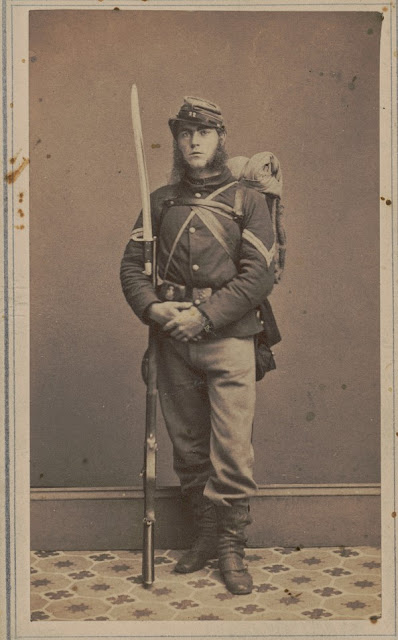
| Roughly 40% of Joe Johnston's infantrymen began the Atlanta campaign toting a .577 caliber Enfield rifle musket or a Confederate made equivalent. The improvement of arms carried by his troops had come a long way from the flintlocks, Brown Besses, and shotguns carried in the early days at places like Belmont and Mill Springs. |
Armament
and Ammunition report for the week ending April 10, 1864
Hardee’s
Corps
80
regiments, 17,006 effective men
.54 caliber 3,070
.577 caliber 8,105
.58 caliber 2,994
.69 caliber 3,191
Total:
17,360
Hood’s
Corps
54
regiments, 16,962 effective men
.54 caliber 6,778
.577 caliber 5,608
.58 caliber 1,034
.69 caliber 3,242
.70 caliber 79
Total:
16,741
Source:
Military
Record of Lieutenant Colonel Hypolite Oladowski, chief of ordnance, Army of
Tennessee, M331, National Archives, pgs. 332 and 341


Comments
Post a Comment