What I Saw at Shiloh: The Tale of Pulaski W. Fuller, 6th Ohio Infantry
Serving as a corporal in the ranks of Co. E of the 6th Ohio Volunteer Infantry, Pulaski W. Fuller opened a lengthy correspondence with the Vermont Standard newspaper in March of 1862, determined to provide his kinfolk with a description of the war as it was being fought in the West.
As the fighting drew to a close on the afternoon of April 7,
1862, Fuller observed that “we now began to realize how dreadful was the work
in which we had been engaged. For miles the woods were strewn with wounded, the
dying, and the dead. The Rebels fled so precipitately as to laves thousands of
their wounded and dead on the field. Never before did I realize the wickedness
of war. Here were no breastworks or fortifications of any kind. Men stood and
deliberately shot each other down as they would the most common game.”
Two of Corporal Fuller’s letters to the Vermont Standard describing Shiloh and its aftermath are reproduced below.
 |
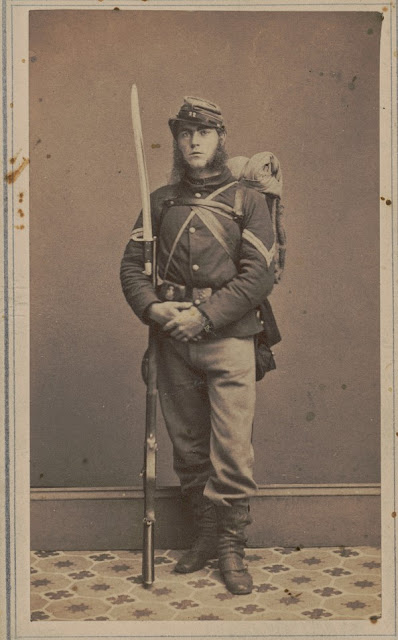
| A native of Boston, Corporal Pulaski Woodman Fuller served three years as a corporal in Co. E of the 6th Ohio Volunteer Infantry, seeing action at Shiloh, Stones River, and Chickamauga. After the war, he and his growing family moved to Long Prairie, Minnesota where he served as a Baptist minister for the remainder of his life. Active with Wood Post No. 100, Fuller passed away at the age of 73 in 1897. His wife's family lived near Woodstock, Vermont before the war. (Image courtesy of Find-A-Grave, Tabby Truxler) |
Pittsburg
Landing, Tennessee
April 10,
1862
Long before this reaches you the
particulars of the great battle fought at this point on the 6th and
7th of the present month will have been published to the world.
Pittsburg Landing on the Tennessee River is in McNairy Co., Tennessee some 20
miles from Corinth, Mississippi where it was understood that General Beauregard
had concentrated a very large force to intercept our advance into the more
southern states. General Grant had landed some 80,000 troops at Pittsburg and
was awaiting the forces of General Buell from Nashville to advance and attack
the Rebel stronghold at Corinth.
No one had the least idea that it was
Beauregard’s intention to attack us.
Our division with General [William]
Nelson at the head left Nashville on the 17th of March and arrived
at Savannah some 8 miles below this point on the 5th of April. After
so long and so tedious a march, we all expected some days of rest, but at
daybreak on the morning of the 6th we distinctly heard heavy cannonading
and soon learned that the force at Pittsburg was attacked. We made all
preparation for a three days’ campaign and by 1 p.m. we were on our way up the
river, marching most of the way through a dense swamp. We arrived opposite
Pittsburg about 5 o’clock.
The scene on the opposite shore beggared
all description. The Union camps had been completely surprised in the morning;
many of the field officers had exhibited the greatest cowardice, leaving their
camp and making for the river upon the first appearance of the enemy. As a
matter of course their regiments soon followed and here were thousands of men,
each looking to his own safety, all panic-stricken and discouraged. We now
learned that the day was lost, the enemy had possession of the camps and camp
equipage of six regiments. One entire brigade with General Prentiss had been
taken prisoners and in one hour more General Sherman (who appears to have been
in command) would have been obliged to surrender.

Four or five steamboats with their
cabins crowded with the wounded were at once employed to convey us to the
opposite shore. General Nelson made his way through the crowd and formed our
brigade consisting of the 6th Ohio, 24th Ohio, and the 36th
Indiana, marching us directly to the front, opened such a fire upon the enemy
as to cause them to desist for the night. We then rested upon our arms.
During the night, General Nelson had
succeeded in getting his whole division into position on our left wing and
center. At daybreak on Monday, we received orders to fix bayonets and forward
march until we should meet the enemy. We had not far to go. The battle commenced
at about 6 a.m. and continued to rage with unabated fury till about 2 p.m. Up until
10 o’clock we had not gained one foot of ground. But General Buell had arrived,
bringing large reinforcements, and as regiment after regiment filed into the
field, the scene was indeed imposing.
We now began to advance, but it was over the dead bodies of
thousands of our fellow soldiers. The line of battle was over 6 miles long and
so steadily did the men push forward that by 1 o’clock we had possession of all
the ground lost on the day previous along with some 600 prisoners and several
of the enemy’s batteries. I learned from a prisoner that General Beauregard had
left Corinth with 80,000 men and while on the road was reinforced by 20,000 men
under General [Leonidas] Polk. General Beauregard had rode up and down the
lines telling the men if they did not drive the northern vandals to the north
side of the Tennessee River he would starve them (his own men) to death. But he
did not succeed and by 2 o’clock commenced retreating in tolerable good order.
By 2 o’clock the firing ceased and for the first time during
the day General Nelson dismounted and partook of refreshment. Our division
behaved most admirably and I believe the excellent generalship displayed by
General Nelson, always moving the regiments at just the right time and quickly
placing them in the right positions, was the salvation of thousands of lives.
General Buell also exhibited great coolness and bravery and fully sustained his
reputation of a great general by promptly brining up the reserves in time to
strengthen and make impregnable every weak point.
By 4 p.m., the enemy had retired from the entire length of
our lines and we now began to realize how dreadful was the work in which we had
been engaged. The ground is somewhat rolling, covered with second growth timber
as the underbrush had been cleared up by our troops. There are no fences and
the only protection afforded to our skirmishers were trees hardly large enough
to cover their bodies. The troops engaged were from all the northwestern states
with Ohio being largely represented.

For miles the woods were strewn with wounded, the dying, and
the dead. The Rebels fled so precipitately as to laves thousands of their
wounded and dead on the field. Never before did I realize the wickedness of
war. Here were no breastworks or fortifications of any kind. Men stood and
deliberately shot each other down as they would the most common game.
We have buried up to this evening over 2,000 Rebel soldiers
and there are many yet to be gathered. Our loss, as near as I can learn up to
this date, is 1,200 killed and 5,000 wounded. It has been the most desperate
and bloody battle ever fought on the American continent. The Rebel army was
liberally supplied with powder and whiskey and fought like demons; every
prisoner we took was intoxicated.
What will be the result of this battle is difficult to
determine at this date. General Albert Sidney Johnston is killed; General
Beauregard is known to be wounded and the recent successes of General Pope on
the Mississippi River will, I should judge, very much dishearten the Southern
Confederacy.
Pittsburg
Landing, Tennessee
April 20,
1862
A delightful Sabbath morning. As I sit
beneath the shade of a tall oak listening to the merry songsters hopping about
over my head, I cannot help contrasting the scene with that of two weeks ago
this morning when, beneath this same tree, a party of officers having just sat
down to their morning repast were startled by a shell bursting within 10 feet
of their rustic table, causing them to adjourn breakfast. And as it was too
late to form their regiment in line of battle, they had to beat a hasty retreat
to a more secure locality, leaving their meal, camp, and camp equipage to their
uninvited guests, Mr. Beauregard and Co.
So sudden and unanticipated was this
attack that the regiments forming the front of our left wing had scarcely time
to get their equipment, indeed many of them fell in without their cartridge
boxes. Thus surprised, they admitted the enemy into their camps almost without
resistance, the Rebel infantry making sad havoc in their ranks as they
retreated. It was these regiments (I forebear to name them) that caused the
panic. The brigades encamped nearer the landing had more time and were fully
prepared to meet the enemy and made a most noble resistance.

Notwithstanding, whole regiments of
panic-stricken men broke wildly through their ranks. General [Stephen] Hurlbut’s
brigade [see "We Generals Must Take Our Chances with the Boys"] manfully maintained their ground and most desperately fought
the enemy for 10 hours. Upon the arrival of General Nelson, the men were nearly
exhausted and readily admitted they could not have held out another hour. How
opportune then was our arrival.
Upwards of 2,600 of the Rebel dead have
been found and buried and so late as yesterday a reconnoitering party
discovered 13 bodies lying together some two miles from the battlefield, men
who must had died of their wounds as they had been dressed and conveyed to that
point. Our own killed, wounded, and missing will reach fully 10,000 and it is
believed the Rebel loss is much larger although they took more prisoners on
Sunday than we did on Monday. Our wounded, thanks to the various sanitary
commissions, are nearly all conveyed to hospitals near their homes where they
will receive much better care than would be possible here.
Since the battle, things have settled
down with little excitement to relieve the ordinary routine of camp life.
Troops continue to arrive and our line of defense is now completed. General
Halleck, having taken personal command at this point, is actively preparing to
advance. Beauregard is actively building fortifications and entrenchments at a
place called Pea Ridge some five miles this side of Corinth. He undoubtedly
expects to receive large reinforcements from Virginia but the indefatigable
General [Ormsby M.] Mitchel arrived at Huntsville, Alabama just in time to capture
15 locomotives, 200 prisoners, and interrupt Beauregard’s dispatch to the
effect that he had 80,000 men and could not hold out unless he was reinforced.
Mitchel having the central and Burnside the seashore railroads, Beauregard’s
chances of succor from the east are meager, indeed.
 |
| Large Bowie knives like this were often carried by eager Confederate volunteers. |
A large number of civilians have
visited the fields of Shiloh, the name of a church a short distance from the
landing, and have converted a large portion of the saplings into walking sticks
for mementoes. Many of the Rebels were armed with huge knives from one half to
two feet long, having the appearance of having been made by a blacksmith and
ground very sharp. These knives proved to be of little use to them. Hundreds of
them were found in the woods and our boys are sending them home as mementoes of
the savage intentions of the Rebels. All the prisoners I have conversed with
testify to the fact that General Beauregard had three regiments of blacks. They
were kept in reserve and not allowed to participate in the fight. Of course,
they are not freemen or we should certainly have met them on the field.
And now, the more I contemplate the
late battle at this place and the better I become acquainted with its details,
the more thoroughly I am convinced that a few such victories would prove our
ruin. Were it in my power to illustrate what I have seen and heard in the last
week, the picture would be anything but flattering to certain generals who
allowed themselves to be surprised, a surprise without parallel in history,
without excuse, palliation, or apology.
General [William T.] Sherman in a
speech to his division on Monday evening after the battle said, “Although I was
perfectly conversant with the locality of the enemy and knew that our pickets
had been skirmishing for three days, yet knowing the forces we had here I could
not make myself believe they would have the boldness to attack us in force.”
And to this surprise alone is attributable four-fifths of our loss. Call you
this generalship?
Many of our regiments ran. If they did, whose fault was it? Surprised, bewildered, and without officers or organization, the wonder is that they stood as well or checked at all the Rebel avalanche. It is fortunate for the country that we have few such generals in the army. I see the Committee on the Conduct of the War are about to investigate the cause of this surprise. This is as it should be. Let the blame of gross negligence, which on that fatal Sunday, exposed our army to such fearful slaughter and the imminent danger of total destruction, rest where it belongs. Should another battle occur I hope not to be so much engaged with the wounded and dying as to prevent my writing to you sooner than before.
To read more about the Battle of Shiloh, click here to visit my Battle of Shiloh page which has links to over 100 articles about this landmark engagement of the Civil War.
Source:
Letters from
Corporal Pulaski Woodman Fuller, Co. E, 6th Ohio Volunteer Infantry,
Vermont Standard (Woodstock, Vermont), May 2, 1862, pgs. 1-2


Comments
Post a Comment