Posts

Amid a Very Hell of Carnage: Charging Jonesboro with the 38th Ohio

Image
  In the years after the Civil War, the veterans of the 38th Ohio gathered each September 1st to renew old ties and discuss their participation in the regiment's hardest fight of the war, the Battle of Jonesboro. The men believed that their charge at Jonesboro represented the regiment's finest hour and its highest loss in a single battle with 152 men killed or wounded. Sergeant Lee H. Rudisill of Co. H penned the following account of the charge at Jonesboro for the August 7, 1890 edition of the National Tribune. 

Marching to Georgia Southern Style

Image
A fter a 430-mile, 24-day march from Tupelo, Mississippi to Chattanooga, Tennessee in the summer of 1862, Mississippi artillerist Benjamin W.L. “Leigh” Butt waxed eloquently on the beauty of the southern landscapes through which he passed. But Chattanooga and specifically Lookout Mountain topped them all.           “Here the scenery which presented itself to view was magnificent and sublime,” he wrote after climbing to the summit. “We were seated apparently in the center of an enormous circle rimmed with ranges of lofty hills, rising one above another until they blend with the distant horizon. Down below us was the scattered town of Chattanooga and at our feet flowed the Tennessee, making its way through the far-off mountains like the windings of a gigantic, glistening serpent.” The Mississippian appreciated Chattanooga’s historic importance. “In after days, this spot and its vicinity will be visited as classic ground. Already these mount...

A Brotherhood of Khaki and Blue

Image
  W ith the nation breathlessly watching as the U.S. Army fought the largest single battle in its history in the closing days of World War I, a 76-year-old Civil War veteran named John C. Newnam from Angola, Indiana penned an impassioned letter addressed to the young men “who are fighting for me in the biggest war that was ever fought in this world.”           “In the war of 1861, I was 18 years old, just growing up in the bloom of life. I was anxious to go to war. I felt it my duty to go. I felt as though I wasn’t excused more than any other young man to face gun powder, shot, and shell. I weighed 118 pounds, was well-muscled, and well-nerved up at that time, but best of all I had in me a heart that said this country must be saved if it costs my flesh and blood,” he wrote. John Newnam may be standing among these veterans of Co. H of the 44th Indiana Infantry. By the time this image was made in the spring of 1864 at Chattanooga, Tennes...

His True Qualities Were Appreciated by all that Knew Him: The Death of Lieutenant Christian Nix at Stones River

Image
O ne of the most poignant relics on display in the Stones River visitor’s center is the grave marker for Lieutenant Christian Nix of the 24 th Wisconsin Volunteer Infantry. Carved into a plank of wood, the marker states “Lieu Nix, 24 th WI, Buried Jan 8.” It is one of the few (if not only) remaining grave headstones that shows how soldiers’ graves were marked in the days immediately following the battle of Stones River. Lieutenant Christian Nix's original grave marker as carved on a wood plank by his comrades of the 24th Wisconsin shortly after the battle. Hundreds of markers like these dotted the landscape around Murfreesboro, many of them quickly wearing away before the graves were moved to the national cemetery starting in 1865. By that time, many of the markers had disappeared or rotted away leaving the identity of those buried beneath them one of the enduring mysteries of the battle. Of the 6,100 Union soldiers buried at Stones River National Cemetery, 2,562 of them (42%) ar...

All the Glory of Whipping Rosy

Image
L ieutenant James H. Fraser’s 50 th Alabama stepped out on the morning of Sunday, September 20, 1863, at Chickamauga eager to get into the fight with the Yankees and determined to not let Longstreet and his Virginia veterans “get all the glory of whipping Rosy.”           “Early in the morning of Sunday the 20 th , we were called to attention, the roll was called, and every man answered “here” loud and lively,” Fraser wrote to his father a week later. “But how many brave soldiers who were then full of life and hope lie cold and stiff in a soldier’s grave with nothing around them but a soldier’s blanket. We made a new graveyard, Pa, and then filled it with our own brave dead.”           Lieutenant Fraser’s detailed account of the fighting on September 20 th first saw publication in the October 8, 1905, edition of the Montgomery Advertiser , being shared with the newspaper by the Joseph E. John...

Salvation Close at Hand: Federal POWs Exchanged at Wilmington

Image
C aptured on the second day of the Battle of Chickamauga, Sergeant Samuel S. Boggs of the 21 st Illinois had survived 18 months imprisonment in some of the worst camps throughout the South: Libby, Belle Isle, Danville, Andersonville, and now at Florence, South Carolina. Attached to the hospital squad, he remained at Florence when many of the haggard survivors moved off to another camp at Goldsborough.           “We of the hospital squad stayed with the sick and gathered from in the prison all the sick we could put under our sheds and arranged the balance so we could give them water,” he wrote. “They were decreasing rapidly by death. The Rebels told us if we would take an oath not to go beyond the stockade, they would take off the guards. We consented, glad to get rid of those murderers and then swore not to hold conversation with the Negroes or slaves and not go beyond the limits of the stockade. The nurses counseled together and agreed to...

Pen Portrait of Stonewall Jackson

Image
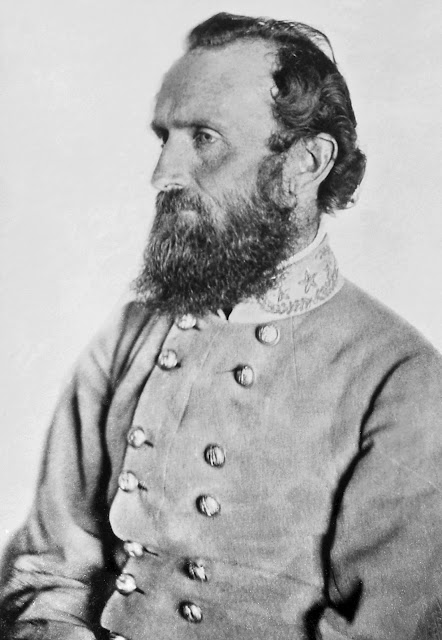
“Stonewall Jackson had dark gray eyes full of strength and depth of expression. They seemed to look through a man and discern his thoughts at a glance.” ~ Colonel William C. Oates, 15 th Alabama