On the Chickamauga Campaign with the 19th South Carolina
While recuperating in an Atlanta hospital after suffering a hip wound on the last day of the Battle of Chickamauga, Sergeant Hugh Wilson, Jr. of the 19th South Carolina cobbled together his notes and assembled the following campaign diary for the editors of the Abbeville Press and Banner. It is a remarkable chronicle of the movements of the Army of the Tennessee in the days leading up to its victory at Chickamauga.
During that campaign, Wilson’s regiment (part of the 10th/19th Consolidated South Carolina) was part of General Arthur M. Manigault’s brigade, General Thomas C. Hindman’s division, of Polk’s Corps. His account first saw publication in the October 2, 1863, edition of the Abbeville Press and Banner.

Camp of 10th
and 19th Regt. S.C. Vols., near Lafayette, Georgia
September 17, 1863
Dear Wilson,
For the past two or three weeks we
have been quite unsettled, remaining only a few days at any one campground.
Since I wrote you my last letter, our troops have evacuated the city of Chattanooga
and have been marching considerably. Twice we thought that we were going into
battle, but each time we were deceived. What General Bragg’s designs are of
course are unknown to us, but all look for a fight here. Our troops are well-disciplined
and appear anxious to meet the enemy.
From fatigue, loss of sleep, etc., I feel but little like preparing a letter for publication and send you a short diary this week. I hope that your readers may find it sufficiently entertaining to keep you posted as to our movements. I have written you this letter without knowing when I may have an opportunity of sending it to you.
Saturday, September 5: The enemy shelled Chattanooga today. Weather warm and dry. All quiet in camp.
Sunday, September 6: This morning we cooked rations and loaded wagons preparatory to leaving, expecting to leave at 6 p.m.
Monday,
September 7: Still waiting
for marching orders. The mules are harnessed and the wagons loaded. Chattanooga
shelled from 10 a.m. to 2 p.m. today. This afternoon, General [Thomas C.]
Hindman addressed the regiments of our division in a stirring speech. The
address was well received and will doubtless be instrumental in cheering and
inspiriting our troops. He said that when we moved we would go to meet the
enemy, to fight him, and whip him; that we could not afford to be whipped now
and that victory or death should be our watchword.
He appealed to the men to put forth every exertion on their part and that could do nothing without them and hoped to meet us after the battle and give us a hearty greeting, etc. When he concluded, our men cheered him as he rode off. After the general had gone, Lieutenant Colonel Porcher reminded us of our dependence upon God for every blessing and suggested that we, as a regiment, should implore divine favor in our behalf. Mr. Richards then delivered an earnest and appropriate prayer. At dusk, canteens were filled with water. No move yet.
 |
| General Thomas C. Hindman |
Tuesday, September 8: Marched this morning towards Lafayette, the courthouse town of Walker County, Georgia. The enemy’s shells were heard in our rear until 1 o’clock. An hour after dark, we stopped on Chickamauga Creek near its fountainhead, having marched 8-10 miles. We drew and cooked a day’s rations and by midnight were ready for sleep and rest. It is thought that Chattanooga was today evacuated by our forces and the troops under Major General [Thomas L.] Crittenden are supposed to have taken possession of the city. No government stores were left there. The evacuation of this stronghold was caused by flank movement of the enemy. Heavy columns of General Rosecrans’ army were moving on the right and left towards Rome, 65 miles in rear of Chattanooga.
Wednesday, September 9: We moved this morning early; marched one mile farther in the direction of Lafayette then halted in the shade of some large trees by the roadside. At 3 p.m., we fell in and marched back to where we rested last night. More rations were drawn and cooked. No mail since Monday morning.
Thursday, September 10: At 1 o’clock this morning we took up the line of march. We marched today in the direction of a pass across Lookout Mountain where an army of 8,000-10,000 of the enemy had just crossed. At 10 o’clock this morning we halted in four or five miles of the pass, having marched 12-15 miles. Bivouacked for the night. No mail.
Friday, September 11: This morning waiting orders to advance upon the enemy. All expect a fight and everyone is confident of our ability to meet them with a successful result. At an early hour, Commissary Sergeant Latimer brought another day’s cooked rations. Weather dry and the sun shines warm. About the middle of the day, we moved towards the enemy and after a few halts and countermarches we came within range of the enemy’s shells, a few bursting near us but doing no damage.
About 5 o’clock, a brisk cannonade was kept up for half an hour. About 9 o’clock, without knowing the result of the movements of the enemy, we marched in the direction of Lafayette. We reached there about daylight the following morning. I do not know the distance we marched tonight but know that it was decidedly the hardest march that we have ever taken. Our men were completely worn down from fatigue and lack of sleep.

Saturday, September 12: The brigade arrived in an open field about daybreak and soon all were asleep. The morning sun beaming on us, apparently with an extra installment of heat, at an early hour made it uncomfortable and we stretched blankets, oil cloths, etc. to protect us from the heat. About noon, Major General Hindman came among us and said we would move to a more pleasant campground when we would cook more rations. Our men appear well pleased with our major general. We moved two miles distance in a forest near a branch and cooked rations. At 10 o’clock tonight, we were ordered to fall in.
Sunday, September 13: By daylight we were at Smoke Hill Church, 8-9 miles distant from Lafayette in the direction of Chattanooga. In the vicinity of this church, several divisions of our army formed line of battle in front of a column of the enemy under the command of Major General Crittenden. Hospital arrangements have been made and all expect a battle today or tomorrow, perhaps the bloodiest of the war. Our men appear eager and confident. At 12 o’clock, a spirited fire commenced by one or two of the batteries and the engagement is expected to be general in a short time. But in an hour, the fire began to be sluggish and in a few minutes after entirely ceased. An hour before sunset we changed our position one mile to the right and rested quietly for the night.
Monday, September 14: The enemy is reported to have fallen back and everything is perfectly quiet. About 9 o’clock, we turned towards Lafayette without the anticipated fight, reaching Lafayette about dark. The dust was never so bad. People in South Carolina have no conception of the density of the dust in this locality. All roads over which the soldiery have marched is from one to three inches deep, light, and easily stirred. The horses, trees, fences, soldiers, citizens, and everything near the road is thickly coated with it. After marching an hour or two it is no trouble for a soldier to blow a couple of dirt daubers our of his nose. The health of our men is good though a few have recently been sent to hospitals. Among others we would mentioned Corporal John W. Cosby of our company [G]; Sergeant S. Hunter has returned to duty.
Tuesday, September 15: All quiet with us this morning. Light clouds flying above, occasionally obscuring the sun’s rays. Oh, that it would rain! No mails since Monday the 7th. It is believed we could have captured a large party of the enemy if we had reached the mountain pass a few hours earlier. Such is the fortune of war. A lack of promptness frustrates the designs of a movement of an army. Reports reached us that the enemy had made a raid down the Atlanta railroad [Western & Atlantic] for 50 miles below Chattanooga, destroying the depots as they went. Dalton is reported as burnt.

Wednesday, September 16: Last night I attended a prayer meeting. Mr. Richards is overzealous in his duty. Through his instrumentality, a Christian Association has recently been organized in the regiment with a large number of members. Prayer meetings are conducted by him two nights of each week in addition to the regular Sabbath services. None could be more anxious for the spiritual welfare of our men. This morning, we were ordered to be in readiness to move by daylight tomorrow morning with two day’s rations in our haversacks. Today we drew bacon, pork, meal, flour, salt, sugar, and soap. Still dry and warm; no mail.
Tuesday, September 17: Expecting to move upon the enemy at an early hour. All are confident that the result will be for the benefit of our cause. It is generally believed that our men were never in better condition to meet the enemy.
At 8 a.m.: We did not move this morning as we expected, the order for moving having been countermanded for today by General Bragg. The wagons are, though, to be kept loaded and ready for a move. General Bragg said in a circular that he “had offered the enemy battle twice but that he had not accepted it. That he would now attack him.” This morning, the baggage was closely inspected and the transportation wagons are fewer now than at any time previous. The indications are that we will have rain soon. No mails yet. We are 24 miles from Dalton which is the nearest railroad station.
At 4 p.m.: Ordered to be in readiness to match in an hour. I am well, having stood the marches very well. Reports reach us that Lieutenant General Ewell has achieved a great victory over Burnside at Strawberry Plains and that he has crossed Cumberland Gap. I trust that it may be true. This day one year ago at Munfordville, Kentucky 5,000 prisoners were surrendered to us.

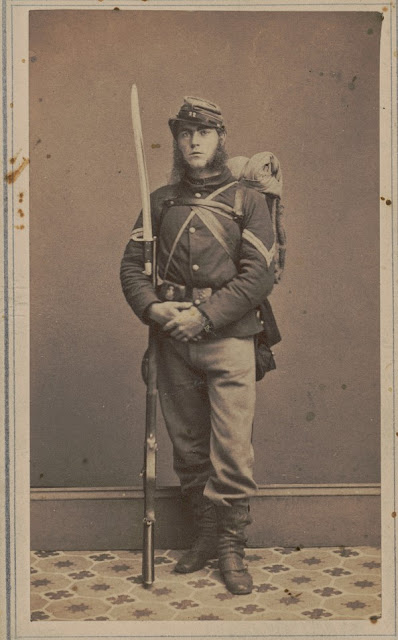
Sergeant Hugh Wilson, Jr., Co. G, 19th South Carolina pictured years after the war.
Greenwood
Mills, Georgia
September
22, 1863
I am now on my way to some hospital in
the interior, having been slightly wounded in the hip on Sunday’s fight on Chickamauga
Creek. We had skirmishing on Friday. Our regiment was under the fire of the
enemy’s batteries for some time with 5 killed and wounded from the 10th
South Carolina. In the line of skirmishers, one was killed and one wounded from
our regiment. On Saturday, a hard fight lasted from 10 o’clock until dark but
our regiment was not engaged.
On Sunday morning, heavy firing
commenced on our right and at noon the enemy’s lines began to give way…[faded]…the
enemy retreating under our fire. Many were killed and wounded on both sides but
the enemy’s loss was greater than ours. We hold the whole of the battlefield.
The result up to Sunday night was a great victory to our arms. The 10th
and 19th South Carolina regiments acted gallantly. The list of their
killed and wounded will show that they were at the post of danger.
Empire
Hospital, Atlanta, Georgia
September
24, 1863
I am now in the Empire Hospital at Atlanta, Georgia, having been sent to the rear on account of a slight flesh wound received in the Battle of Ringgold in Sunday’s fight. The papers have informed you of the character of the fight on Saturday and Sunday. Our brigade suffered severely in killed and wounded. I am unable to send you a full list of casualties at present.
Yours
hurriedly,
H.W.
Later that fall, a medical examining board described Wilson as having a gunshot wound in his left hip and the “wound unhealthy” and “still suppurating.” He spent months recovering from his wound at St. Mary’s Hospital in LaGrange, Georgia before being transferred to Covington in June 1864. He never returned to the regiment, taking the oath of allegiance May 11, 1865, at Charlotte, North Carolina. A printer by trade, the Abbeville Press and Banner regularly printed his insightful chronicles of life in the Army of Tennessee through much of 1863 under the banner of “from our junior correspondent.” After the war, Wilson operated the Abbeville Press and Banner for more than 40 years, passing away December 17, 1917, at the age of 79.
Source:
Letter from Sergeant
Hugh Wilson, Jr., Co. G, 19th South Carolina Infantry, Abbeville
Press and Banner (South Carolina), October 2, 1863, pg. 1


Comments
Post a Comment