Posts

On soil enriched with their blood: The aftermath of Gettysburg
Image
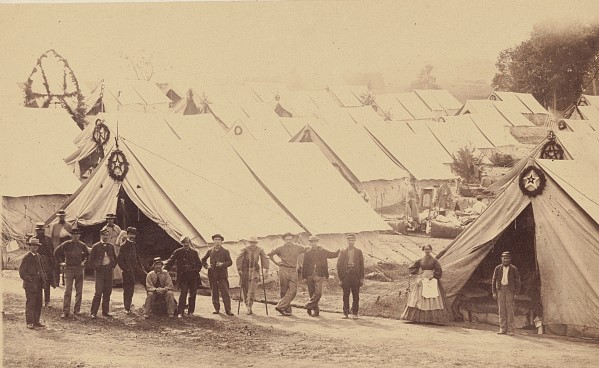
  S hortly after the conclusion of the Battle of Gettysburg, Ohio editor George G. Washburn traveled to the battlefield to render assistance to the wounded men of his local 8 th Ohio Infantry. The scale of the horrors he witnessed in the coming days proved staggering.           South of the copse of trees near the center of the Union line on Cemetery Ridge, he reported that “along this whole line the ground is covered with muskets, knapsacks, clothing, broken caissons, and all the paraphernalia of war while the stench arising from the shallow graves and dead horses utterly baffles description,” he wrote. “An occasional farmhouse is seen riddled with shells and deserted by its former occupants. The floors are clotted with blood where the wounded were first borne in the heat of the action and in one chamber I saw where a shot passed through near the floor and out on the opposite side; the whitewashed wall was besmeared with the brains a...
Sunbrowned and War-Worn Stalwarts: A Character Study of Western Federals

Image
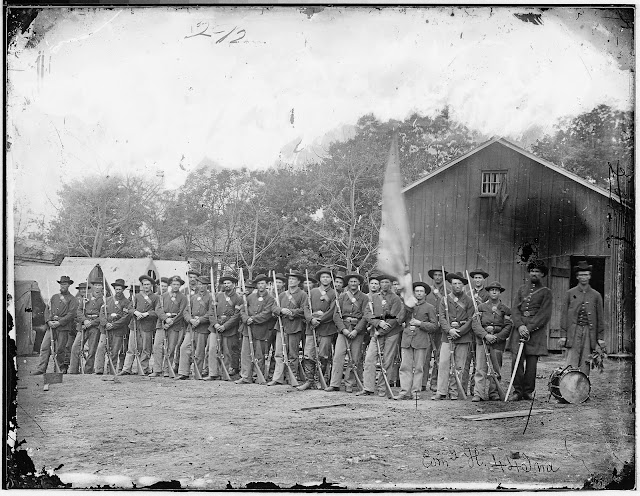
 " They are tall, stalwart fellows, looking rather thin, sunbrowned, and war-worn. But there was something in the firm step, intelligent look, and resolute bearing of those tall, sinewy, iron-framed warriors that showed the thinking mind, and unfailing energy of the true soldier.” ~ New York Daily Herald , May 25, 1865

Knocking on the Front Door of Rich Mountain with the 4th Ohio

Image
     Following the brief engagement near Carrick's Ford in western Virginia, Corporal Levi Graybill of the 4th Ohio had a chance to see the first general killed in the Civil War, Brigadier General Robert Selden Garnett of the Confederate army.       "H e looked like a great man and not a bad one," Graybill confessed. "He was a man of medium size, had a high and intellectual forehead, a brow pensive but not gloomy, a mouth of inflexible decision, a face pale but serene, and he had every appearance of being a man of great thought. He was placed in a coffin and sent to Grafton to be shipped to his home in Richmond. No one could look on him as he lay in his coffin dressed in his uniform looking as though he was enjoying the sweet slumbers of life without feeling sorry for him. Yet all must acknowledge that his death has rid our country of one of its most powerful enemies."      A West Point graduate of the class of 1841,  Garnett had be...

Taking Fort Hindman with the 76th Ohio

Image
  W illiam H. Buckins was among the first men in Ohio to “win Uncle Sam’s lottery,” being drafted into Co. K of the 76 th Ohio in October 1862. Three months later he found himself tasked with charging against the Confederate works at Fort Hindman in Arkansas.      “ Our colonel came around giving each company orders what was to be done,” Buckins wrote. “He said we were to take the advance of our brigade and the 26 th Iowa was to be our support, that we were to make the first charge along the whole line and if we gained the ravine, we were safe. This did not appear to be a very pleasant job, but still we had to bear the good with the bad.”      The regiment moved out but soon had to take cover behind downed trees as the Confederate fire proved too heavy to advance against. “We gained the ground within 300 yards of their breastworks, when we all fell to the earth and found that the trees they cut down were our only protection,” he said. “We then op...

We Felt a Little Streaked: At Burnside's Bridge with the 21st Massachusetts

Image
The Rohrbach Bridge was one of three bridges that crossed Antietam Creek near Sharpsburg but is certainly the most well-known. Often referred to as the Burnside Bridge, it is one of the most iconic sites on the Antietam battlefield. Here General Edward Ferrero's brigade crossed the bridge under a heavy fire from Robert Toombs' Georgians and Private Charles Crafts of the 21st Massachusetts was wounded as he describes in his letter below. (Image courtesy of Phil Spaugy) During the Battle of Antietam, General Ambrose Burnside’s IX Army Corps was tasked with taking the Rohrbach bridge across Antietam Creek and among the troops employed to accomplish that objective was Private Charles Ransom Crafts of the 21 st Massachusetts Volunteer Infantry. After taking the bridge, the regiment fell under Confederate artillery fire where it appeared the Rebels threw everything they could find at the Federals. “The Rebels came down on us in force and opened on us with their batteries,” Crafts ...

Saving the Day at Parker's Crossroads

Image
      A fter three weeks of fruitlessly chasing General Nathan Bedford Forrest’s command around western Tennessee in late 1862 and early 1863, Corporal Edwin P. Toms of the 27 th Ohio suggested the government adopt a new approach.      “I should like the Times to recommend to Governor Tod to mount the Ohio brigade,” he offered. “We are pretty good walkers, but hardly enough to catch Rebel cavalry. If we are to be kept as a sort of police guard to run after Rebel cavalry every time they make a raid, we shall certainly want other legs than those nature has provided us with. Had we been mounted at the Battle of Parker’s Crossroads on the 31 st of December, nothing would now be known of Forrest’s gang except the history of its capture.”      The 27 th Ohio as part of Colonel John W. Fuller’s Ohio brigade arrived on the field at Parker’s Crossroads just as Colonel Cyrus Dunham’s Federal brigade was surrounded and about to surrender. F...

I Don't Thirst for More Fight: An Iron Brigade Sergeant Remembers Gainesville and Second Bull Run

Image
The men of General John Gibbon's brigade became known as the Black Hat Brigade since they wore the regulation black Hardee hats like the one shown above that belonged to a soldier in Co. C of the 2nd Wisconsin. Comprised entirely of western regiments (19th Indiana, 2nd, 6th, and 7th Wisconsin, later to be joined by the 24th Michigan), the brigade became well known as "one of the most colorful and distinguished brigades that fought for the Union," stated historian Alan Nolan. After proving their mettle at Gainesville, Second Bull Run, South Mountain, and Antietam, they became known as the Iron Brigade of the Army of the Potomac. The red circle on the hat dates from 1863 and represents the corps badge for the First Brigade of the First Division of the I Army Corps.  The fight at Gainesville, Virginia on August 28, 1862, marked the first time Sergeant Willie Hutchins of Co. B of the 6 th Wisconsin of the Iron Brigade had seen action. The former native of Vermont struggled w...