Posts

Winged at the Outset: Wilbur Hinman’s Experiences at Chickamauga

Image
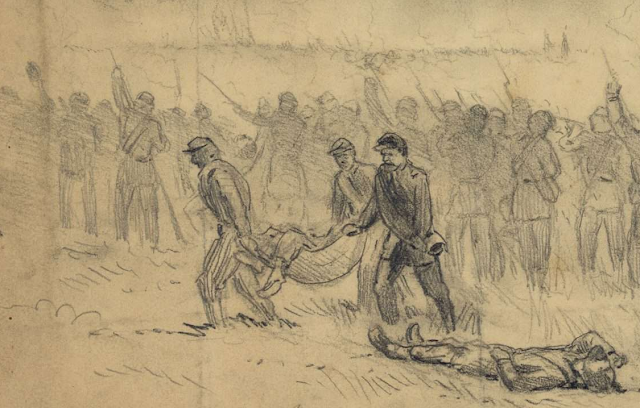
F irst Lieutenant Wilbur F. Hinman of the 65 th Ohio, who later gained much notoriety for his books Si Klegg & His Pard and The Story of the Sherman Brigade , penned this reminiscence of his experiences being wounded at Chickamauga. This story was included in his 1892 anthology Camp and Field: Sketches of Army Life Written by Those Who Followed The Flag, ’61-’65.

A Fighting Chaplain at South Mountain

Image
G eorge Gilman Smith was never comfortable with his reputation as a fighting chaplain. “A year before I had been the pastor of a charming little church in a beautiful valley of upper Georgia,” he recalled. “I was just married and ought to have stayed at home, but when I saw my parishioners going to the front, I went, too, as chaplain of the Phillips Legion. I did not go into the army to fight and I did not fight when I got there; I had as little stomach for fighting as Falstaff. I went to the army as a chaplain yet that day at South Mountain I got a bullet through my neck.” Phillips' Georgia Legion served as part of General Thomas Drayton's brigade of General David R. Jones division of Longstreet's Corps. The Georgians lost heavily in the fighting at South Mountain; by the end of the engagement, the survivors were led by a lieutenant.              The Phillips Legion had 15 companies- nine of infantry, five of cavalry, and on...

An act of practical Christianity

Image
A fter losing both of his legs to amputation at Second Bull Run, Corporal James Tanner of the 87 th New York recalled a striking instance of what he called “practical Christianity,” as he lay amongst the wounded and the dying. The men had gone without food or water for several days and one mortally wounded man, whose name is lost to history, crawled in agony from the tent to a nearby apple tree. Stuffing a half dozen worm-eaten apples that had fallen to the ground into his coat pocket, he crawled back to the tent and gave them to his comrades. It was his final act. Within moments, the man was dead. “I have often thought that in his last act he exhibited so much of what I consider the purely Christ-like attribute,” Tanner recalled. “What that man’s past life had been, I know not. It may have been wild and his speech may have been rough. I know that he was unkempt, unshaven, his clothes soiled with dirt and stained with blood. Not a picture that you would welcome at first sight into...

Lost in the blaze, thunder, and frenzy of battle: With the Blythe’s at Shiloh

Image
A s Blythe’s Mississippi regiment went into action at Shiloh on Sunday morning, April 6, 1862, they encountered General Beauregard and staff but ran into a serious problem: the general’s coach lay astride the regiment’s path directly in front of Captain James DuBerry’s Co. C.             “Captain DuBerry was a good fighter but he had supreme contempt for the finesse drill and this obstruction, stretching the full front of his company filled him with perplexity," remembered Captain Benjamin Sawyer of Co. I. “Had it been a four-gun battery confronting him, he would have been at no loss for action but that gaudy coach, with its caparisoned team, was more than his tactics ever provided for. Without knowing how to flank it, he marched his company squarely against it when the men halted and looked around in confusion.”             “The regiment was aligning upon the colors and of ...

Echoes of Battle Volume 2: Fredericksburg to Fort Sanders

Image
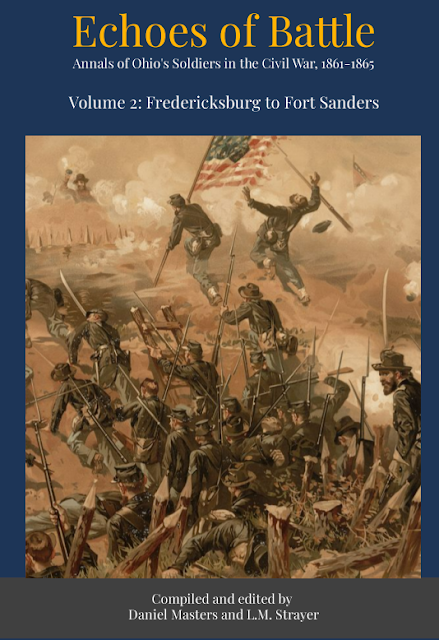
     Echoes of Battle: Annals of Ohio's Soldiers in the Civil War Volume 2: Fredericksburg to Fort Sanders  is the latest in  a three-part series compiled and edited by Dan Masters and Larry Strayer presents 109 firsthand battle accounts written by Ohioans during the Civil War covering the critical middle period of the war from December 1862 through November 1863.      It was a war fought upon some of the bloodiest stages in American history such as Gettysburg, Chickamauga, and Antietam, and at obscure skirmishes such as Scary Creek, Snaggy Point, and Limestone Station. These Ohioans will recount the thrill of victory at Shiloh, Vicksburg and Missionary Ridge, and the sadness and demoralization of defeat at Chancellorsville, Fort Wagner, and Brice’s Crossroads. The horrors of war will come home with stark clarity from places such as Port Republic, Corinth, Stones River, and Franklin. Sailors will recount their battles with Confederate forts a...
Breaking the Macon and Western Railroad

Image
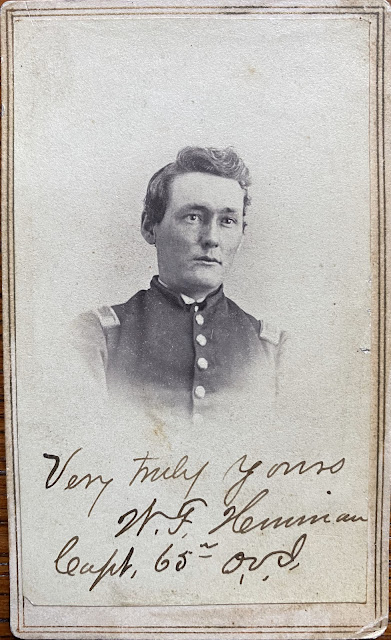
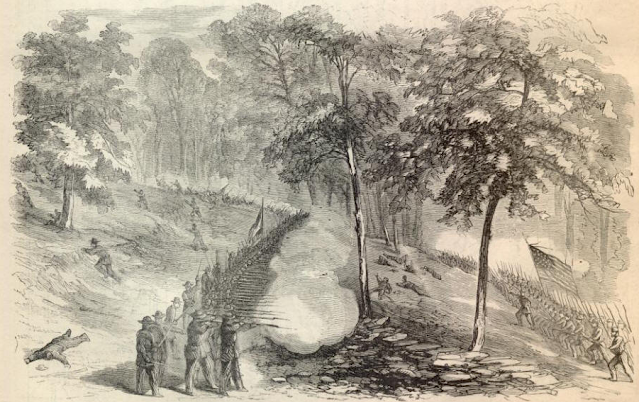
D uring its nearly three years’ service with the Army of the Cumberland, the veterans of the Fourth Army Corps had repeatedly suffered when the Confederates had broken their “cracker lines.” In late August 1864, “Uncle Billy” finally gave the boys a chance to get even when he directed the army to swing around the west side of Atlanta and break the Macon & Western Railroad. After an all-night march, Captain Wilbur Hinman recalled the relish with which his men dove into the work of destruction. “Language can but faintly describe the scene that ensued as the boys were in high spirits and laughed, yelled, sang, and jested with infinite enjoyment,” he remembered. “The day was hot, and under the scorching sun the sweating and dust-begrimed soldiers pounded, pried, and lifted, tearing up the rails and pulling the ties from the ground. Others were engaged in collecting dry brush and rails and lighting a long row of fires. Merrily the men poked and fed the roaring fires until the ties wer...

Knapsack Compression: Wilbur Hinman recalls the first step of becoming a veteran

Image
L ooking back on his experiences during the war, Captain Wilbur Hinman of the 65 th Ohio (perhaps best known as the author of Si Klegg and His Pard ) recalled that the first road along which his regiment marched was strewn “with debris. A pair of six-mule wagonloads might have been gathered of notions that had been flung aside by a thousand suffering “tenderfeet.” “The average young patriot started for the war with a wheelbarrow load of clothing, a bed quilt or two, books, photograph albums, toilet articles, and gimcracks of every sort,” he wrote. “Neither he nor the good homefolks had the slightest conception of the capacity of a knapsack, nor did they for a moment imagine that before the close of his first day upon the road every pound he carried would seem a hundred.” To the true mark of a veteran soldier was one who “learned to dispense with every unnecessary ounce of weight, and just in the ratio that he did this he increased his efficiency as a soldier. It was of the highest...